
Em 1896, Henri Becquerel descobriu uma nova radiação enigmática. Ao contrário dos raios X que desapareciam quando o tubo dos mesmos era desligado, esta radiação observada do Urânio era emitida continuamente. Estudos mais aprofundados levados a cabo por Pierre e Marie Curie relevaram que existiam outros elementos que possuíam a mesma propriedade. Em particular, descobriram estas propriedades no polónio e no rádio, em 1898.
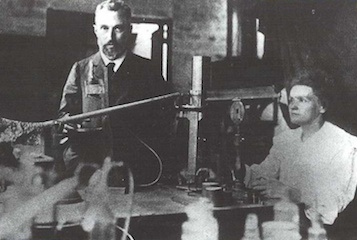
Pierre e Marie Curie rapidamente encontraram uma utilização para esta propriedade e, já em 1901, o rádio estava a ser utilizado em hospitais. Sabia-se que a radiação proveniente do rádio possui efeitos benéficos para muitas doenças cutâneas, inclusivamente o cancro.
Pierre e Marie Curie no seu laboratório, Paris 1898.
A nova radiação era de origem nuclear. Alguns núcleos emitem espontaneamente partículas α (núcleos de hélio), partículas β – que podem ser eletrões (β-) ou positrões (β+) – e/ou raios γ (gama) (i.e., fotões de alta energia). Um átomo com um núcleo instável, caracterizado por possuir uma energia excessiva é designado como radionuclídeo, nuclídeo radioativo, ou ainda radioisótopo ou isótopo radioativo.
Exemplos de radioisótopos naturais são o 238U (urânio), 40K (potássio), 232Th (tório) e os seus núcleos filhos 226Ra (rádio), 222Rn (rádon), 218Po (polónio). Alguns radioisótopos são continuamente produzidos por ação da radiação cósmica nas camadas mais superiores da nossa atmosfera, como por exemplo, 14C (carbono), 3H (trítio) ou 7Be (berílio).
Irène e Frédéric Joliot-Curie foram os primeiros a produzir radioisótopos artificiais em 1933, ao utilizarem uma fonte α natural para bombardear alumínio-27 e produzir o elemento radioativo fósforo-30 que decai por decaimento β para silício-30. Este foi o resultado dos núcleos dos átomos de alumínio ao receberem protões adicionais a partir de núcleos de hélio (partículas α).
Desde então, muitos novos radioisótopos têm sido produzidos, alargando o número de novas aplicações e conduzindo a uma melhor compreensão da matéria nuclear e das forças nucleares. Por volta de 1936, já 200 radionuclídeos tinham sido produzidos. Atualmente são conhecidos cerca de 250 nuclídeos estáveis. São produzidos utilizando feixes de partículas, que vão desde protões até ao 238U, acelerados em ciclotrões ou aceleradores lineares.
O primeiro acelerador (ciclotrão) foi construído em Berkeley, nos Estados Unidos em 1932 por Ernest O. Lawrence. Ele e o seu irmão John Lawrence - médico - rapidamente reconheceram aplicações médicas de grande importância, e produziram isótopos radioativos para investigações biológicas e médicas, bem como para o tratamento de cancros. O primeiro ciclotrão Europeu foi construído por Frederic Joliot (1939) no College de France, Paris.
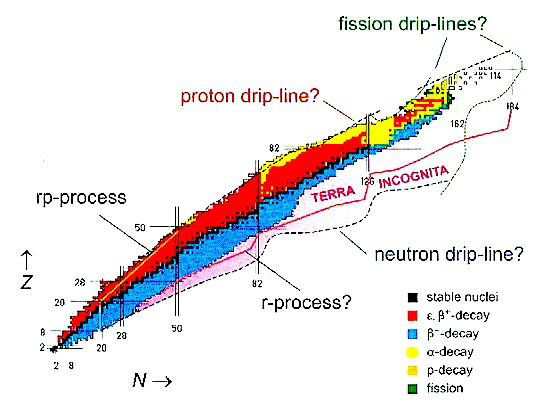
Físicos têm produzido muitos novos isótopos que se encontram cada vez mais afastados do vale da estabilidade nuclear natural. Atualmente, existem muitas instalações que utilizam feixes de iões radioativos. A procura de radioisótopos para fins medicinais é um fenómeno mundial, e nos países desenvolvidos tem vindo a crescer exponencialmente desde 1995.
O prémio Nobel da Química de 1943 foi atribuído a G. de Hevesy por ter sido o pioneiro no uso de elementos radioativos naturais (e mais tarde artificiais) como traçadores no estudo de elementos estáveis em sistemas biológicos. Uma pequena quantidade de um elemento radioativo pode ser facilmente observada no corpo humano. Isto também é conseguido através de traçadores químicos, porém seria necessária uma maior quantidade de químicos, o que levaria ao aumento de risco do procedimento para o paciente.
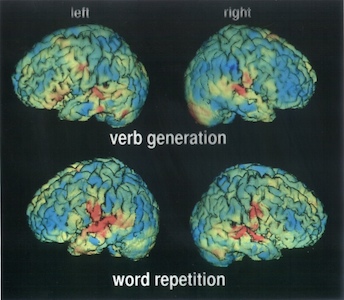
Tipicamente, numa investigação medicino-nuclear um traçador é administrado ao paciente e os raios γ emitidos pelo nuclídeo traçador são registados com uma matriz de detetores de radiação. Este processo é chamado de tomografia por emissão. O marcador é frequentemente escolhido de modo a que este se deposite seletivamente num órgão particular, e que depois os raios γ detetados forneçam uma imagem detalhada da região de interesse. Para um olhar experiente, as imagens podem revelar anomalias estruturais ou metabólicas conduzindo a melhores diagnósticos. Na medicina nuclear há uma grande quantidade de isótopos que são utilizados, cada um destinado especificamente para os órgãos individuais do corpo humano.
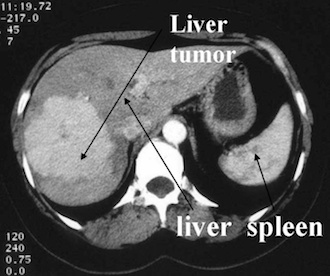
Imagem acima: aplicação de PET em neurofisiologia (exercício de memória verbal no cérebro), Hospital San Raffaele, Milão.
Os tumores podem ser localizados com técnicas como a Tomografia Computorizada por Emissão de Fotão Único (SPECT) ou a Tomografia por Emissão de Positrões (PET) (em que núcleos emissores de positrões (β+) são utilizados para produzir – por um processo de aniquilação – raios γ energéticos). As técnicas de SPECT e PET são típicas em diagnóstico de tumores, bem como em estudos funcionais do cérebro normal saudável.
Imagem de uma tomografia computorizada usando raios-X a partir de um marcador de iodeto (Hospital Erasme, Bruxelas).
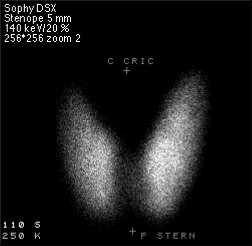
Entre os elementos radioativos, o Iodo (I) tem um papel único, já que este se liga ao tecido da tiroide com grande afinidade e seletividade. Para doses reduzidas pode ser utilizado para fins diagnósticos, ou, alternativamente, podemos proceder ao tratamento do cancro da tiroide aproveitando a radiação emitida do Iodo radioativo, que se liga exclusivamente a tecidos da tiroide.
Os elementos químicos fisiologicamente mais intrigantes como o C (carbono), N (nitrogénio) e o O (oxigénio) apresentam emissões β+de isótopos de curta vida usados em técnicas de PET. Os nuclídeos de emissão beta normalmente utilizados são 11C, 13N, 15O e 18F (flúor).
Imagem à direita: Cintigrafia da atividade da tiroide usando tecnécio.
SPECT significa Tomografia Computorizada por Emissão de Fotão Único. Neste procedimento, os órgãos são visualizados medindo a distribuição de um radiotraçador injetado por meio de uma «câmara» gama ligada a um computador. A imagiologia SPECT envolve a rotação de uma matriz de detetores gama à volta do paciente para adquirir medições de múltiplos ângulos. Com esta técnica procura-se a posição e a concentração da distribuição do radionuclídeo. A SPECT utiliza radioisótopos como o 99mTc, ou o 123I, nos quais é emitido um único γ (de 140 keV).
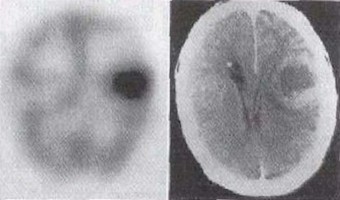
Há muitas aplicações da SPECT, tanto no diagnóstico como enquanto auxiliar de terapia. Os exames SPECT que usam um radioisótopo não absorvido pelos tecidos, mas que circula na corrente sanguínea, podem mostrar como o sangue chega a determinados tecidos e órgãos. Isto é particularmente útil em exames ao cérebro e ao coração.
Na técnica de Tomografia por Emissão de Positrões (PET), os isótopos habitualmente utilizados são 15O, 13N, 11C e 18F. Estes têm tempos de meia-vida curtos, de cerca de 2, 10, 20,4 e 110 minutos, respetivamente, pelo que os radioisótopos têm de ser produzidos perto do local onde são usados. Por esta razão, muitos hospitais dispõem de um pequeno ciclotrão nas proximidades ou mesmo dentro do próprio hospital, especialmente construído para produzir estes isótopos. O isótopo é depois ligado a uma substância natural como glicose, água ou amoníaco, que é então introduzida no corpo humano por injeção ou eventualmente por inalação sob a forma de gás. O radioisótopo desloca-se para a parte do corpo que utiliza a substância à qual foi ligado, razão pela qual se usam muitos tipos diferentes de substâncias.
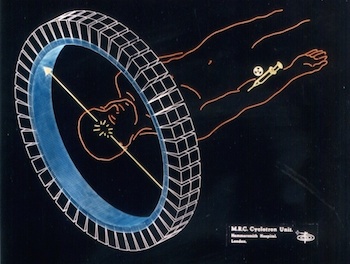
As partículas elementares têm antipartículas correspondentes. A antipartícula de uma partícula é essencialmente a mesma partícula, mas com carga elétrica oposta. Quando uma partícula e a sua antipartícula colidem, aniquilam-se com emissão de energia pura.
Os isótopos tipicamente utilizados num exame PET são emissores β+ . Quando o isótopo decai no interior do corpo do paciente, qualquer positrão (β+) emitido percorre apenas uma curta distância no tecido (tipicamente menos de 1 mm, dependendo do isótopo) antes de se aniquilar com um eletrão (β-). A energia libertada na aniquilação surge sob a forma de um par de fotões gama (γ) emitidos a 180° um do outro, com uma energia de 511 keV cada. A deteção dos dois raios γ em coincidência por dois detetores permite localizar o acontecimento de decaimento sobre a reta que une os dois detetores.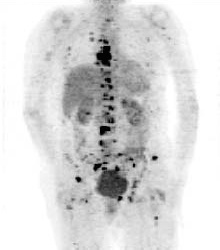
Os exames PET são habitualmente usados para diagnosticar cancros, doenças cardíacas e algumas perturbações cerebrais como a epilepsia ou a doença de Alzheimer. A PET é também utilizada na avaliação da resposta à terapia oncológica. Além disso, os exames PET são usados em investigação, por exemplo em estudos sobre os efeitos do consumo de drogas ou do envelhecimento.
Os riscos associados a um exame PET são muito reduzidos mas, tal como na maioria dos tipos de exame, nem sempre é adequado a mulheres grávidas ou a amamentar. Devido à presença de uma substância radioativa no corpo, os hospitais aconselham os doentes a evitar qualquer contacto próximo com grávidas ou crianças pequenas durante pelo menos algumas horas após um exame PET.
Imagem de um exame PET mostrando cancro dos ossos do esqueleto (Hospital Erasme, Bruxelas).A imagiologia SPECT é inferior à PET em termos de resolução e sensibilidade atingíveis. Para a PET, a melhor resolução espacial atualmente atingível é de cerca de 6 mm, ou seja, 2 a 3 vezes melhor do que com a SPECT. Devido ao seu rápido decaimento, praticamente todos os isótopos PET têm de ser produzidos no local (com exceção do 18F, com meia-vida de 110 min). Em contrapartida, os isótopos SPECT como o 123I têm uma meia-vida suficientemente longa (13,2 horas) para permitir a produção centralizada em locais distantes, com entrega posterior por correio expresso.
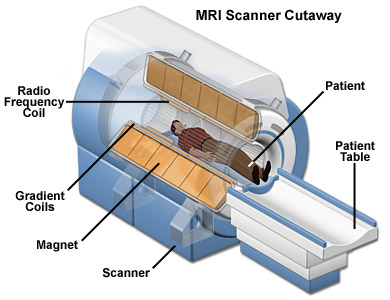
A principal vantagem da MRI é não utilizar qualquer substância radioativa. As imagens de MRI mostram a distribuição da água (H2O) no corpo e os órgãos onde esta está armazenada. A MRI é essencialmente um grande tubo com ímanes potentes no interior. Isto deve-se ao facto de os protões nos núcleos de H se comportarem como pequenos ímanes. Quando se aplica um campo magnético externo em torno do paciente (o que não é prejudicial), todos esses pequenos ímanes presentes na água são alinhados numa direção. Quando o protão regressa bruscamente à sua posição, liberta ondas de rádio que o aparelho de MRI pode então detetar e medir para formar uma imagem 2D do corpo. A MRI é habitualmente usada em diagnósticos do cérebro ou do coração, mas pode ser usada para examinar quase qualquer parte do corpo.
A tecnologia de MRI continua a ser desenvolvida para responder a um leque mais vasto de problemas de diagnóstico clínico. Por exemplo, Xe-129 ou He-3 polarizados podem ser usados para visualizar as vias respiratórias nos pulmões com elevada resolução espacial e temporal.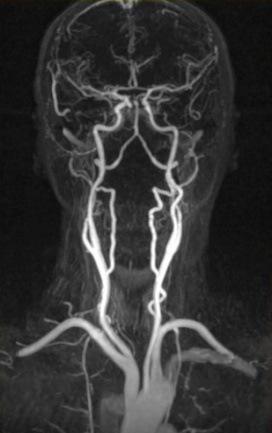
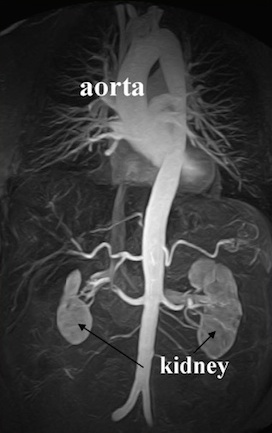
O prémio Nobel da Medicina de 2003 foi atribuído a Paul Lauterbur e a Sir Peter Mansfield pelo seu trabalho e contributo para a Imagiologia por Ressonância Magnética.
A maioria dos hospitais modernos e universitários utiliza hoje MRI e PET, a par de outras técnicas de imagiologia. Em muitos institutos de Física Nuclear existem grupos cujas atividades e investigação se dedicam a aplicações médicas específicas, bem como ao tratamento de doentes, por exemplo no GSI (Alemanha), PSI (Suíça), GANIL (França), HMI (Alemanha) ou LARN (Bélgica).A terapia com partículas consiste em dirigir partículas ionizadas ao tumor visado. A ionização danifica indiscriminadamente o ADN das células. No entanto, as células cancerosas têm menor capacidade de se repararem e são mais afetadas por estes danos.
As partículas utilizadas incluem protões, neutrões ou iões carregados positivamente. Cada tipo de partícula tem uma energia diferente e pode, por isso, penetrar no corpo humano a profundidades diferentes. É por esta razão que se usam diferentes tipos de partículas em diferentes procedimentos. O tipo mais comum de terapia com partículas é a protonterapia.
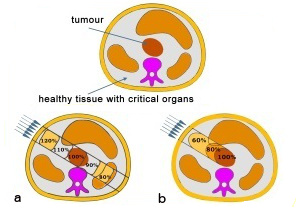
Um problema fundamental da radioterapia é a necessidade de maximizar a dose administrada no tumor, minimizando simultaneamente os danos no tecido saudável em redor. Nas radiações eletromagnéticas (raios X ou γ), uma grande fração da dose atinge o tecido saudável ao longo do feixe, à frente e atrás do tumor.
Consegue-se hoje uma melhoria da radioterapia usando feixes de partículas de alta energia (p, iões pesados), porque nos feixes de iões a dose aumenta com a profundidade de penetração até um máximo no final do alcance da partícula. A terapia com feixes de iões permite depositar no tumor uma dose maior e mais eficaz do que qualquer outro tipo de terapia externa.A imagem em cima à direita mostra a comparação de dois procedimentos. A terapia com fotões (a) deposita uma dose elevada de radiação no tecido saudável à frente do tumor. No caso de um feixe de partículas (b), a maior parte da dose fica confinada ao tumor.
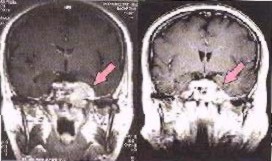
A imagem à esquerda mostra um exame a um cancro do cérebro antes e seis semanas depois da radioterapia com fotões e iões de carbono.
Até hoje, mais de 50 000 doentes em todo o mundo foram tratados com feixes de protões. O tratamento de tumores oculares com feixes de protões dá, de longe, os melhores resultados clínicos. A protonterapia é também ideal quando o tumor está próximo de um órgão crítico, pois pode ser dirigida com grande precisão. Quanto melhor a conformidade entre o volume irradiado e o volume alvo, melhores os resultados. O mesmo se aplica aos feixes de iões pesados, com os quais se pode conseguir uma conformidade superior à dos protões. A terapia com iões pesados foi pioneira em 1974 no Lawrence Berkeley Laboratory. Os primeiros tratamentos recorreram a iões de Ar (árgon) e, mais tarde, a iões de Si (silício) e de Ne (néon). Os tumores irradiados situavam-se perto de órgãos críticos no cérebro, na cabeça ou no pescoço. Os resultados foram excelentes e motivaram a construção de aceleradores médicos dedicados a iões pesados.
A braquiterapia é uma forma de radioterapia em que se coloca material radioativo dentro do corpo, próximo do tumor. As vantagens deste procedimento são que a radiação não tem de percorrer o tecido saudável desde o exterior do corpo para alcançar o tumor, afetando apenas uma área localizada. Isto significa que podem ser administradas doses relativamente elevadas com risco mínimo. Além disso, o doente mantém-se móvel durante todo o tratamento. O tratamento global é normalmente concluído em menos tempo do que outros procedimentos, pelo que há menos tempo para as células cancerosas se multiplicarem entre sessões.
A braquiterapia é uma técnica padrão para alguns cancros ginecológicos, como o cancro do colo do útero ou da próstata, e para certos estádios de carcinomas da cabeça e do pescoço. Nas doenças da próstata têm sido usadas várias abordagens, ditadas sobretudo pelo isótopo escolhido. 125I (com uma meia-vida de 60 dias) e o 103Pd (com uma meia-vida de 17 dias) são usados em implantes permanentes. Estes isótopos podem ser produzidos por captura de neutrões em reatores. 103Pd pode ser produzido de forma mais eficiente em ciclotrões (com feixes de protões de 14 MeV). Nos EUA existem mais de 10 anos de dados clínicos sobre a utilização do 103Pd na braquiterapia da próstata. Este sucesso clínico, aliado à ausência de efeitos secundários, tornou-o uma opção terapêutica muito procurada.
O Sol emite luz visível, radiação infravermelha que sentimos como calor e radiação ultravioleta que, infelizmente, pode ser perigosa. A radiação ultravioleta pode causar melanoma da pele (cancro da pele). O melanoma da pele é uma das causas mais comuns de cancro e, em 2008 por exemplo, matou cerca de 46 000 pessoas em todo o mundo.
A taxa de diagnósticos de melanoma maligno quadruplicou nos últimos 30 anos. Encontra-se mais frequentemente em pessoas com história familiar de cancro da pele, em pessoas de cabelo e pele claros e em pessoas com mais de 40 anos. No entanto, qualquer pessoa pode desenvolver cancro, independentemente da origem, da idade ou da genética. A maior parte dos danos na pele ocorre antes dos 20 anos, mas muitas vezes só se manifesta aos 40, pelo que, mesmo que não se veja a arder, continua a danificar a pele. É por isso que é tão importante usar protetor solar e evitar o Sol quando está mais forte (entre as 11 e as 15 horas).


 BG
BG DA
DA DE
DE EN
EN ES
ES FI
FI FR
FR GR
GR HU
HU IT
IT NL
NL NO
NO PL
PL RO
RO SE
SE