
Porque é o carbono mais abundante que o ouro no universo, e de onde vêm estas substâncias? Esperamos que esta questão seja respondida até ao fim desta secção relacionada com os blocos de construção que constituem todo o universo. Perceber estas unidades básicas permite-nos manipular as suas propriedades para melhorar as nossas tecnologias e para a satisfação das nossas necessidades em constante mudança. Tudo, desde o mais pequeno chip no seu iPad, a si, até as maiores galáxias do universo, são constituídas por aquilo que hoje chamamos de átomos. O estudo dos átomos e os seus comportamentos levou a umas descobertas bastante interessantes e úteis, sem as quais não existiria sequer um iPad. Continue nesta secção e aprenda sobre os constituintes básicos da árvore que consegue observar da sua janela, bem como de si mesmo!
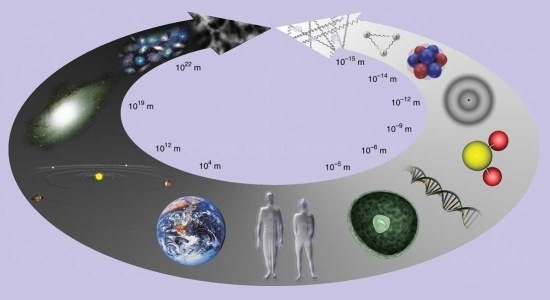
Se lhe pedissem para imaginar uma maçã, incluindo o seu comportamento, a sua aparência e o seu tamanho comparativamente a outros objetos, o faria sem problemas. Isto acontece sobretudo, embora sem nos apercebermos, porque uma maçã é da mesma ordem de grandeza que o mundo com o que regularmente interagimos. Também é fácil visualizar, por exemplo, um computador ou outro Ser Humano. Tentar imaginar um único grão de areia ou a escala avassaladora das montanhas comparativamente a nós mesmos é bem mais complicado. Isto é a razão por que as nossas mentes têm tanta dificuldade em compreender a escala do universo, ou o tamanho de um átomo.
| Nome | O Número | Prefixo | Símbolo | bilião | 1 000 000 000 000 | tera | T | mil milhões | 1 000 000 000 | giga | G | milhão | 1 000 000 | mega | M | milhar | 1 000 | quilo | k | centena | 100 | hecto | h | dezena | 10 | deka | da |
| unidade | 1 | décima | 0,1 | deci | d | centésima | 0,01 | centi | c | milésima | 0,001 | mili | m | milionésima | 0,000 001 | micro | µ | mil milionésima | 0,000 000 001 | nano | n | bilionésima | 0,000 000 000 001 | pico | p |
Poderá pensar que, em escalas tão diferentes, não pode existir qualquer ligação entre os átomos e as galáxias. No entanto, os cientistas
perceberam há relativamente pouco tempo que não é possível compreender plenamente os processos que ocorrem dentro de uma galáxia sem
compreender de que ela é feita ao nível mais básico dos átomos e abaixo dele. A física nuclear, em particular, atravessa este enorme fosso
entre escalas, como verá num capítulo posterior sobre as estrelas e o processo criticamente importante da nucleossíntese estelar.
Vamos agora observar com mais detalhe a matéria que constitui tudo aquilo que vemos
>


 BG
BG DA
DA DE
DE EN
EN ES
ES FI
FI FR
FR GR
GR HU
HU IT
IT NL
NL NO
NO PL
PL RO
RO SE
SE